


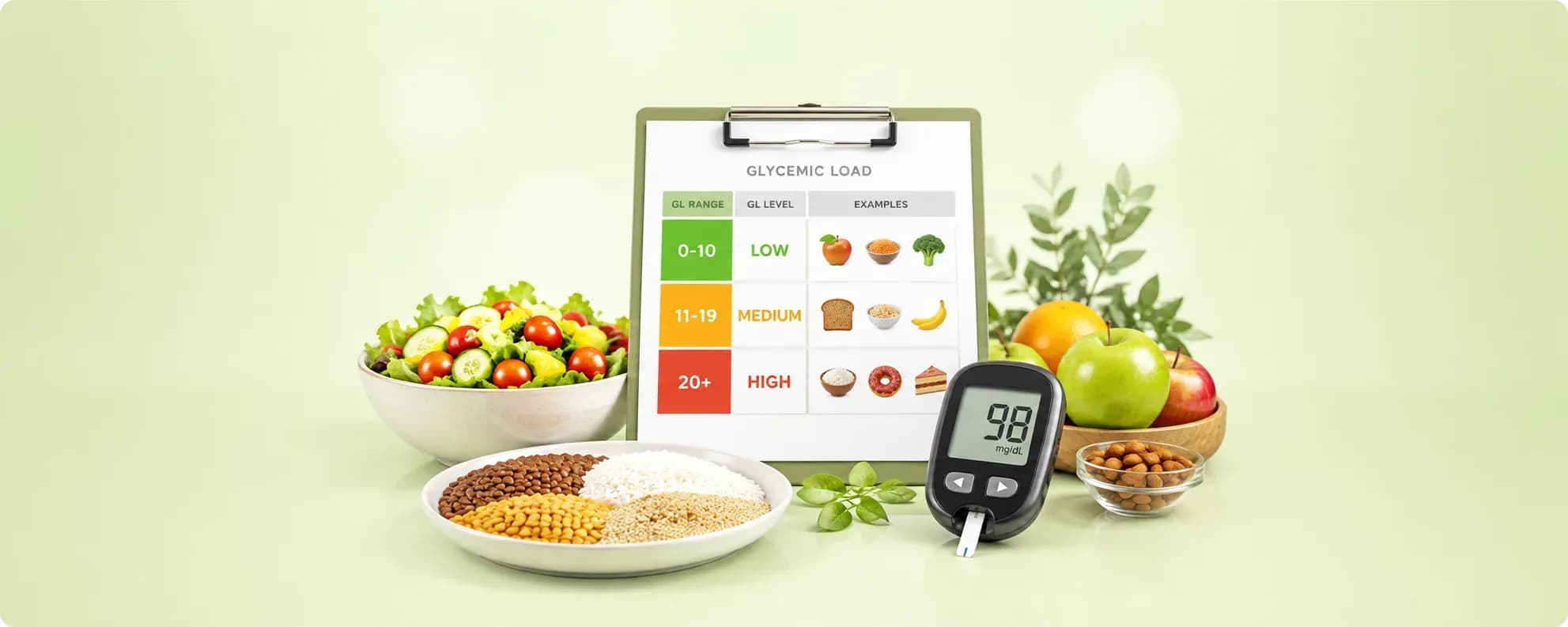
Asha is a 42-year-old banker living in Nagpur. She has had diabetes for the past four years. Asha is super conscious about her diet - she reads nutrition labels, checks the carbohydrate content of every snack, and never eats anything without knowing its glycemic index (GI). She is proud of how well she manages her meals.
One day, during a regular follow-up with her nutritionist, she mentioned how GI has been her go-to guide for meal planning. That’s when her nutritionist told her that GL matters more than GI. Asha was puzzled. She had never heard of GL before and immediately asked, “What is that? And how is it important for my food choices?”
If you are like Asha - mindful of what you eat but still unaware of glycemic load (GL), then this blog is for you. Let’s see what GL is, how it differs from GI, and why it’s important for better diabetes management.
What is Glycemic Load (GL)?
Let’s say you’re trying to choose between two foods - watermelon and chocolate. You might think that watermelon, because it has a higher glycemic index (GI), will spike your blood sugar more than chocolate, which has a lower GI than watermelon.
But there’s more to the story, and that is where Glycemic Load (GL) comes in.
While the glycemic index (GI) only tells us how quickly carbs in food raise blood sugar, GL gives us the whole picture by considering both how quickly the carbs act and how many are in the food. So, it’s not just about how quickly something raises your blood sugar, but also how much sugar and carbs you're actually eating in that portion.
We will explain this, but first, have a look at this comparison between 100 grams of watermelon and 100 grams of chocolate:
| Food | Watermelon* (100 grams) | Chocolate** (100 grams) |
|---|---|---|
| Carbohydrate (gm) | 8 | 57 |
| Sugar (gm) | 6 | 56 |
| Fat (gm) | 0 | 31 |
| GI | 74 | 40-50# |
| GL | 4 | 20-33 |
| Impact on Blood Sugar | Quick spike due to low fat and high water content | Slower spike due to delayed digestion from fat |
*as per USDA
**of a familiar brand
Watermelon has a high GI of 74, meaning its carbs are quickly absorbed and raise your blood sugar quickly. However, watermelon has very few carbs to begin with, so the GL (which combines speed and quantity) is low (4). That means even though the GI is high, watermelon doesn’t raise your blood sugar as much in reality, especially when eaten in smaller portions.
On the other hand, chocolate has a lower GI (40-50) because it is high in fat, which slows the rate at which sugar is absorbed into your blood. However, chocolate has a lot of carbs in a small serving, which increases its GL (20-33). So, even though it might not spike your blood sugar as quickly as watermelon, it can still raise your blood sugar a lot more overall because of the amount of carbs in a small piece.
Hence, watermelon is a healthier choice than chocolate.
So, if we had to simplify this even further:
Say a car is speeding down the road (high GI); it won’t go far if it doesn’t have much fuel. That’s like watermelon - it raises blood sugar quickly, but there aren’t many carbs, so the effect is negligible.
On the other hand, chocolate is like a car driving slowly because of extra weight (fat), but it has a lot of fuel (carbs), so it can travel farther. This means it raises blood sugar for a longer period, even though the rise starts slowly.
So, GI tells you how fast food affects your blood sugar, but GL shows you how much it affects your overall blood sugar control. That’s why you need to pay attention to both, especially when managing diabetes.
Not All Low-GI Foods Are Good, and Not All High-GI Foods Are Bad
The idea that all low-GI foods are always good and all high-GI foods are bad is not entirely correct. Here’s why:
1. Low-GI Foods May Still Be Unhealthy
Foods high in fat or protein may have a low GI but be unhealthy overall. For example, fried pakoras have a low GI but are high in unhealthy fats and calories.
2. High-GI Foods May Not Always Be Bad
Foods with a high GI can have a low GL when eaten in small portions. For instance:
- Watermelon has a high GI (~74) but a low GL (~4) because it contains minimal carbs per serving.
- Grapes have a moderate-to-high GI (60–70), but their GL remains low (~7–9) when eaten in controlled portions, such as a small handful.
Now, let’s take a closer look at Glycemic Load (GL) to understand how the amount of carbs in a food really affects your blood sugar. To do so, we first need to understand the GL categories.
Glycemic Load Categories
| Category | GL Range | Impact on Blood Sugar |
|---|---|---|
| Low | 1–10 | Minimal impact; stable blood sugar levels. |
| Medium | 11–19 | Moderate impact on blood sugar. |
| High | 20 or more | Significant impact on blood sugar. |
Why Knowing the Glycemic Load of Foods is Important for People with Diabetes?
Let’s take a common example: There’s a myth that people with diabetes can’t eat potatoes. In reality, the problem arises when you pair potatoes with other high-GL foods, such as roti or rice. This increases the overall GL, which can spike blood sugar levels.
So, for better blood sugar management, our VP of Metabolic Health at PB Health recommends it’s better to choose one - either potato, roti or rice, but NOT any of them together or in pairs.
Another example to explain this is that enjoying aloo tikki in a day is fine, but eating aloo tikki followed by, say, aloo paratha or aloo sabzi with rice or roti during the same day in a meal is not ideal because you end up increasing the glycemic load, which is not good for your blood sugar levels.
Here is how GL can help in many practical ways:
1. Better Blood Sugar Control with Smart Meal Planning
GL helps you understand how portions of different foods affect your blood sugar and lets you enjoy them in balanced amounts. For example:
- A small bowl of dal khichdi (low-GL) helps keep your blood sugar steady.
- A small bowl of white rice (moderate GL) can cause a blood sugar spike unless paired with dal or sabzi.
- Two medium whole wheat rotis (moderate GL) are fine when paired with dal or salad.
2. Reduces the Risk of Diabetes Complications
Eating foods with lower GL reduces the risk of complications associated with diabetes, such as cardiovascular disease and insulin resistance.
Now, let's look at the GL of some of the foods we eat daily.
Glycemic Load Chart of Foods Commonly Consumed
1. Foods with High GL Values (20 or over)
| Food Item | Serving Size | GL Value |
|---|---|---|
| White rice (boiled) | 1 cup | 23 |
| Paratha (stuffed) | 1 serving | 22 |
| Gulab jamun | 2 pieces | 25 |
These values indicate that these foods can significantly increase blood sugar levels, making them less ideal for those monitoring their glycemic response.
2. Foods with Medium GL (11–19)
| Food Item | Serving Size | GL Value |
|---|---|---|
| Roti (wheat) | 1 medium | 14 |
| Dosa | 1 large | 15 |
| Mango | 1 medium | 12 |
These foods have a moderate impact on blood sugar levels and can be consumed in moderation as part of a balanced diet.
3. Foods with Low GL Values (4–10)
| Food Item | Serving Size | GL Value |
|---|---|---|
| Dal (lentil curry) | 1 bowl | 7 |
| Cucumber | 1 cup sliced | 5 |
| Guava | 1 medium | 8 |
Foods in this category are generally better choices for maintaining stable blood sugar levels.
Are There Any Problems with Using Glycemic Load?
While glycemic load (GL) is a useful tool for managing blood sugar, it has some limitations:
1. Complexity
GL values depend on the glycemic index (GI), which can vary by food (e.g., the ripeness of any fruit), making GL values less consistent.
2. Requires Detailed Calculations
To calculate GL accurately, you need both the GI of the food and the exact carbohydrate content in the portion size. This can be tricky with mixed dishes like vegetable pulao or sambar rice, where ingredients and portions differ.
3. Can Be Confused for Mixed Meals
The glycemic response of mixed meals can be unpredictable because foods interact, altering their overall GI, and hence, GL.
For example:
- Adding daal (such as besan or moong daal atta) to the regular roti dough slows digestion and lowers its glycemic impact, which is favourable.
- Pairing rice with dal reduces the GL compared to eating rice alone.
Is Glycemic Load Right for You?
Glycemic Load (GL) is a practical tool for managing blood sugar, especially for people with diabetes or those pursuing weight management goals. It helps you understand how different portion sizes impact your blood sugar.
For example, 100 grams of plain cooked rice has a higher GL than 100 grams of vegetable pulao, which contains spices and oil that can slightly lower the GI and, hence, the GL. Even 100 grams of jeera rice (cooked with cumin and ghee) will have a different GL due to the rice's roasting, which reduces its glycemic response.
However, GL calculations are cumbersome - they don’t account for individual variations in blood sugar response, and calculating them for every meal can be impractical.
8 Super Practical Tips for Healthy Eating
Our Nutritionist recommends that, beyond just focusing on GI or GL, making mindful food choices every day is essential for better health and blood sugar management. Here are 6 super tips from her on how you can make mindful food choices every day:
- Stick to Balanced Portions: Always eat in controlled amounts, whether it’s rice, chapati, or snacks. Overeating - even healthy foods - can lead to blood sugar spikes.
- Choose Whole and Fresh Foods: Go for fresh vegetables, fruits, dals, and whole grains instead of processed or refined items like biscuits, white bread, or instant noodles.
- Avoid Sugary Packaged Drinks & Processed Snacks: Replace soft drinks, sweetened juices, flavoured milk, and packaged snacks with healthier options such as water, buttermilk, unsweetened lemon water, and fresh, homemade snacks like roasted chana, jhaal moodi, etc.
- Snack Smartly: Opt for roasted chana, nuts, or homemade snacks like vegetable upma over fried snacks like samosas or chips.
- Cook Wisely: Use less oil and spices while cooking to keep meals light and easy to digest. Avoid heavy gravies or overly spiced dishes.
- Be Mindful of Eating Out: When eating out, choose simple dishes like plain dosa, dal tadka, or roti-sabzi instead of fried items or rich curries.
- Limit Desserts: Enjoy small portions of sweets occasionally, and choose healthier options like fruit salads without added sugar.
- Hydrate Well: Drink plenty of water throughout the day to help regulate blood sugar and improve digestion.
Conclusion
Glycemic Load (GL) helps you understand how both the type and amount of carbohydrates in food affect blood sugar. It gives a clearer picture than Glycemic Index (GI) alone. Choosing low-GL foods, controlling portion sizes, and eating balanced meals can help people with diabetes better manage their blood sugar and maintain good health.
How PB Health Can Support You?
PB Health is a complete healthcare platform designed to support you at every step of your health journey. From preventive health checks and doctor consultations (in-person or online) to specialist care, hospital treatment, recovery, follow-ups, and home care, everything is coordinated in one place. PB Health also helps with insurance coordination, making the entire care process smoother and less stressful for you and your family.
To learn more about our approach, visit our website, PB Health.