

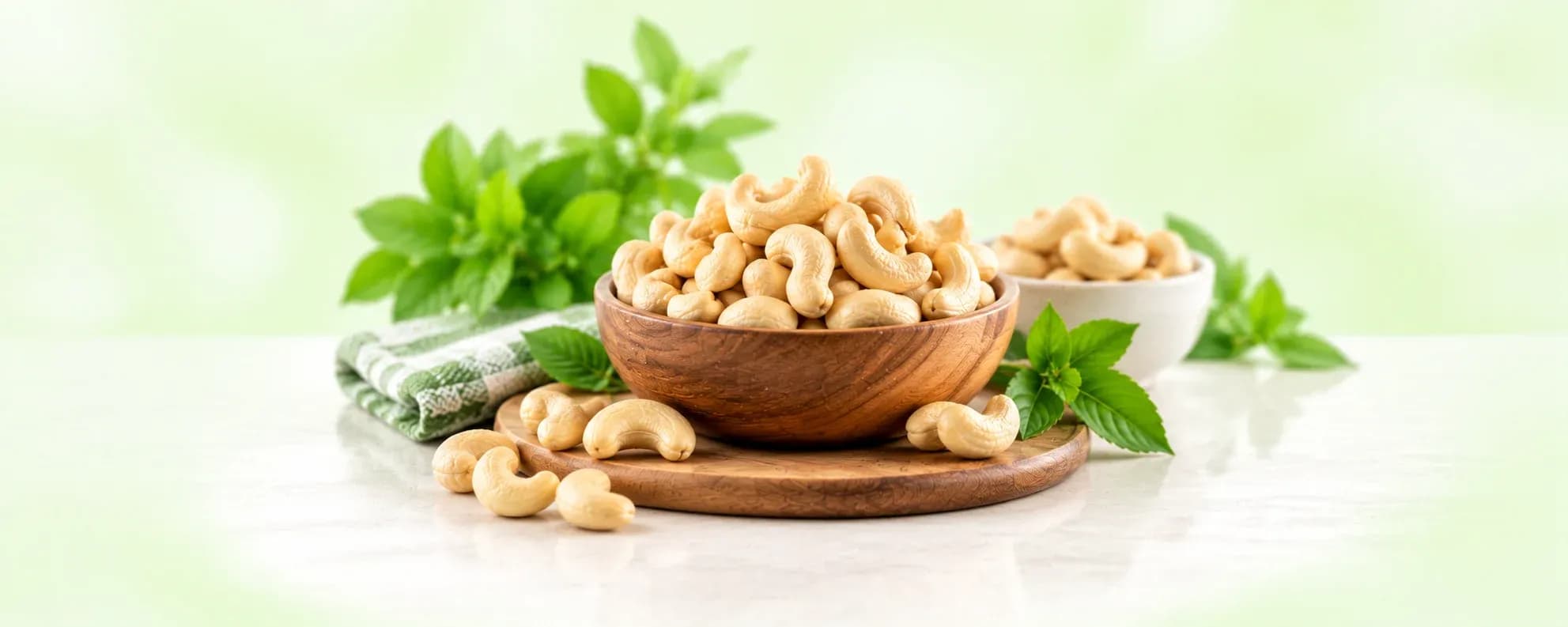
Nuts are a source of healthy nutrients and are often added to meals to enhance their flavour and texture. Though commonly consumed as snacks, nuts like cashews (kaju), almonds(badam), pista, apricots (khubani), etc., find their way into many Indian sweet dishes and baked items.
In this world of nuts, cashews often take centre stage with their versatile flavour profile and buttery texture. But are cashew nuts good for people with diabetes? Let’s find out!
Nutritional Value of Cashew Nuts
To understand more about cashew nuts, we must dive deep into their nutrient profile. The nutrients present in cashew nuts, as per IFCT 2017, are:
| Nutrient | Nutritional Value (in 100g)* |
|---|---|
| Dietary Fibre | 3.9 g |
| Protein | 18.8 g |
| Carbohydrate | 25.5 g |
| Calcium | 34 mg |
Nutritional value of Cashew Nuts
Besides these nutrients, cashews contain amino acids and plant compounds with antioxidant properties, which reduce the risk of chronic diseases like diabetes. So, YES! The yummy cashew nuts are good for people with Diabetes. But you must keep some things in mind. Let’s learn more about how cashew nuts are good for people with diabetes.
Glycemic Index of Cashew Nuts
Cashew nuts have a glycemic index (GI) of 25, making them a low-GI food. So, does cashew nuts increase blood sugar? Well, they don’t! Since cashews have a low GI, they prevent a spike in blood sugar levels.
Health Benefits of Eating Cashew Nuts
Due to the galore of nutrients present in cashew nuts, they offer several health benefits. These include
1. Good for your heart: Cashews contain mono- and polyunsaturated fatty acids, which help increase good cholesterol levels in the blood. So, when cashews are eaten as part of a diet low in saturated fats and cholesterol, they may be good for your heart.
2. Help in weight management: There is a common misconception that since nuts are high in fat, they contribute to increased body weight and cholesterol. For this reason, many people with diabetes and other chronic diseases are often afraid to eat nuts.
However, the fat and fibre content in cashews contributes to high satiety. Therefore, eating cashews as part of mixed nuts can keep you full longer, preventing unhealthy snacking and overeating during mealtime.
Are Cashew Nuts Good for People with Diabetes?
Several small studies on cashew nuts have shown that regular consumption can reduce serum insulin levels in people with type 2 diabetes mellitus. Cashews also have an ideal fat ratio, meaning they are low-fat nuts with less fat per serving than other nuts like almonds, walnuts, peanuts, and pecans.
Since cashews are high in dietary fibre, they help in weight management.
Being low in carbohydrates and free sugars and having a low GI makes cashew nuts safe for people with diabetes. At the same time, though high in fat content, cashews contain ‘good fat’ which is healthy for people with diabetes.
In a study conducted in India, 150 people were given 30 g of unsalted raw, broken cashew nuts daily for 12 weeks while maintaining their prescribed diabetes-friendly diet. They were told not to consume any other nuts.
At the end of the study, it was found that there was a significant increase in good cholesterol levels and a decrease in blood pressure. The study also highlighted that cashew consumption during the study did not increase the participants’ blood sugar levels or weight.
The ability of cashew nuts to help with weight management further makes them beneficial for diabetes management. However, you must always consult with your dietician before consuming cashews.
How Many Cashews Can a Person with Diabetes Eat?
According to IFCT, saturated fats form 18% of the total fats. For this reason, portion control is important while consuming cashew nuts, especially in people with diabetes.
So, how many cashews can a person with diabetes eat? It is best to ask your diabetologist and dietician.
Cashews Dos and Don’ts
Though cashews are healthy, here are some Do’s and Don’ts that you must follow while consuming them:
Do’s
1. Eat in moderation: Eating excess cashews can cause an increase in your weight. So, you must always eat them in moderation.
2. Eat them with other nuts: Dietitians recommend eating 20 g of mixed nuts daily. For example, you can include 2-3 cashews, 2 pistachios, 2-3 almonds, 1 walnut, etc.
Don’ts
1. Avoid using cashews as a gravy thickener: Love eating dishes like paneer or chicken makhni and indulging in the thick gravy? These curry pastes contain lots of cashews.
However, to achieve the required thickness, plenty of cashews are added. This may be harmful to your health.
Use watermelon or sunflower seed pastes instead of cashews to thicken your gravy. They are half the cost and half the calories.
2. Cashews in sweets are not healthy: Yes, eating cashews is healthy, but not when you eat them in sweets like kaju katli, gajar ka halwa and laddoos.
3. Flavoured Cashews: Though cashews are inherently tasty, several processed forms of the nut are found today- masala kaju, peri peri kaju, caramelised kaju, kaju chikki, etc. These variants make cashews even more palatable and tempting, often promoting excessive and uncontrolled consumption of the nut, especially in social gatherings.
This excessive consumption of cashews is accompanied by an excessive intake of salt and preservatives, which is unhealthy.
How PB Health Can Support You
When someone in your family needs medical care, you shouldn’t have to worry about what happens next or who will manage each step.
At PB Health, MG Road, Gurgaon, we believe good healthcare requires proper planning and regular follow-up. Our doctors and care teams work together using technology to track progress, schedule follow-ups, and keep all information clear. From prevention to recovery, every step is handled carefully so nothing important is missed.
To learn more about our approach, visit the PB Health website.