


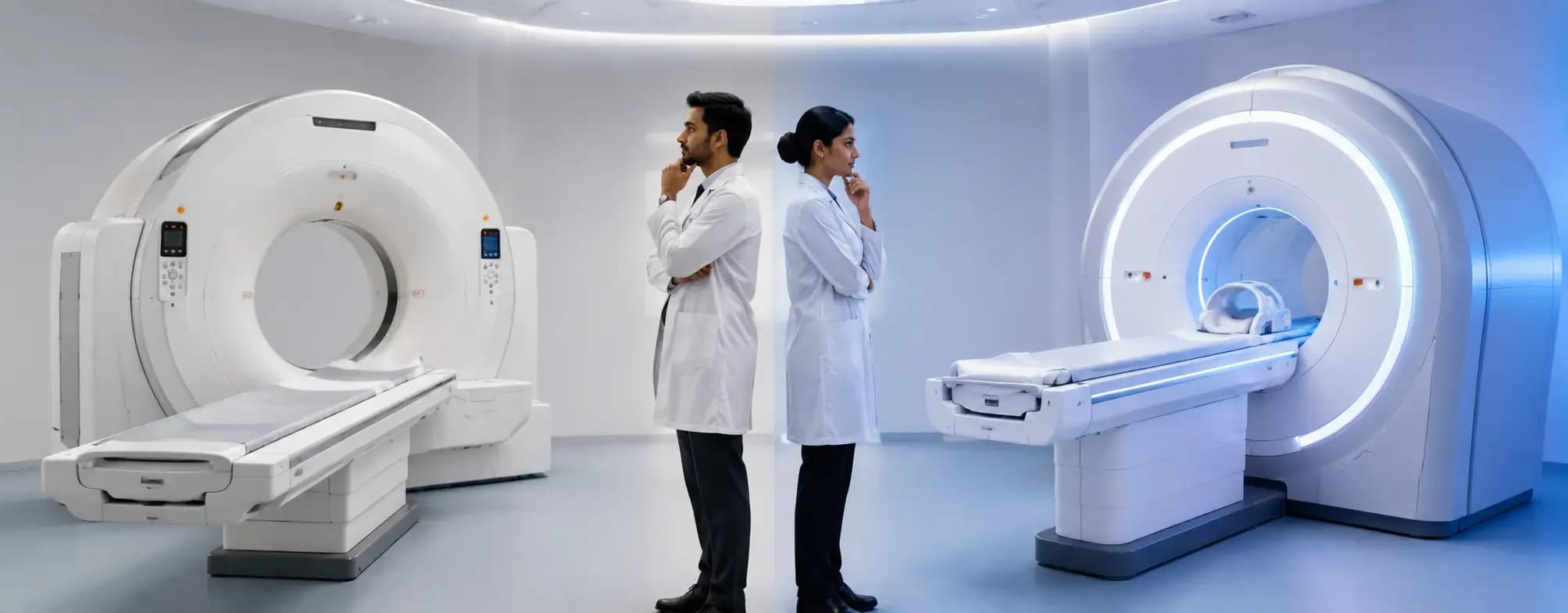
If your doctor has recommended a scan, it's natural to want to understand why. CT (Computed Tomography) and MRI (Magnetic Resonance Imaging) are both used to look inside the body without surgery, but they use different technology and are suited to different situations. Knowing the difference can help you feel more prepared and informed before your appointment.
At a Glance
| CT Scan | MRI Scan | |
|---|---|---|
| How it works | Multiple X-rays detectors arranged in an array and computer processing | Magnetic field and radio waves combined with computer imaging processing |
| Radiation | Small dose of ionising radiation | None |
| Scan time | A few minutes | 15–45 minutes, sometimes longer |
| Best for | Bones, chest, trauma, bleeding, rapid diagnosis | Brain, spine, joints, muscles, soft tissue detail |
| Typical setting | Emergencies and time-sensitive cases | Planned, detailed diagnostic evaluation |
What Is a CT Scan?
A CT scan uses an array of X-ray sources and detectors and computer processing to build detailed, cross-sectional images of the body. Because it takes only a few minutes, it's often the first scan doctors turn to when a fast diagnosis matters.
A CT scan is commonly used to evaluate:
- Head injuries
- Bone fractures
- Lung conditions
- Internal bleeding
- Stroke
- Certain cancers
What Is an MRI Scan?
An MRI scan uses a powerful magnetic field and radio waves, rather than radiation, to produce highly detailed images of organs and soft tissue.
Doctors often recommend an MRI scan to examine:
- The brain and spinal cord
- Ligaments and tendons
- Muscles and joints
- The liver and other abdominal organs
- The heart
- Certain tumours
Because MRI captures soft tissue in much finer detail than CT, it's often the preferred choice when a more thorough assessment is needed.
The Main Difference
Both tests create detailed images of the inside of the body, but they get there in different ways. A CT scan uses X-rays, which makes it especially useful for evaluating bone, lung disease, trauma, and internal bleeding. An MRI scan uses magnetic fields instead of radiation, and excels at showing soft tissue such as the brain, spinal cord, muscles, joints, and certain organs.
Neither test is "better" overall — the right choice depends on what your doctor needs to see.
When Is a CT Scan Preferred?
Your doctor may recommend a CT scan if:
- You've experienced an accident or injury
- Internal bleeding is suspected
- A stroke needs urgent evaluation
- A bone fracture requires detailed imaging
- Lung disease or a chest injury needs assessment
Because CT scans are usually completed within a few minutes, they're especially valuable when time is critical.
When Is an MRI Scan Preferred?
An MRI may be recommended when detailed soft tissue imaging is needed, for example:
- Persistent headaches or neurological symptoms
- Back or neck pain related to the spine
- Sports injuries affecting ligaments or tendons
- Joint injuries
- Certain heart or liver conditions
- Assessment of some tumours
MRI exams generally take longer than CT scans, but that extra time often buys much greater detail for specific conditions.
Is One Scan Safer Than the Other?
Both CT and MRI are considered safe when used for the right clinical reason.
A CT scan involves a small dose of ionising radiation. For most patients, the value of an accurate diagnosis outweighs this small risk, and your healthcare provider will only recommend a CT scan when it's genuinely needed.
MRI doesn't use radiation, which makes it a good option when repeated imaging may be needed over time. However, because MRI relies on a strong magnetic field, it may not be suitable for people with certain implanted medical devices or metal fragments in the body. Your care team will assess what's safest for you based on your medical history.
What Determines MRI Scan Cost?
MRI is generally more expensive than CT. This is largely because MRI equipment is more advanced, scans take longer to perform, and image processing is more complex.
The exact cost of an MRI can vary depending on:
- The part of the body being examined
- Whether contrast dye is required
How Does Your Doctor Decide?
The choice between a CT and an MRI comes down to your symptoms, medical history, physical examination, and the specific question your doctor needs answered.
For example, someone with a suspected stroke may first have a CT scan to quickly rule out bleeding, followed later by an MRI for a more detailed look at the brain tissue. A sports injury involving a torn ligament, on the other hand, is more likely to call for an MRI from the start.
The goal isn't to pick a "better" scan — it's to choose the test that gives your doctor the clearest picture for your specific situation.
Conclusion
CT and MRI are both valuable diagnostic tools, but they serve different purposes. CT is usually preferred for emergencies, bone injuries, and lung conditions because it's fast and effective. MRI, which relies on magnetic imaging rather than radiation, offers more detailed views of soft tissue such as the brain, spine, muscles, and joints.
Rather than asking which scan is better, it's more useful to understand that each has a specific role — and your doctor will recommend the one that fits your symptoms and condition.
How PB Health Can Support You
We understand that diagnostic tests can feel overwhelming, especially when you're not sure what to expect. At PB Health, our radiology team works closely with your treating doctor to recommend the most appropriate imaging investigation for your condition. Whether you need an MRI, a CT scan, or another diagnostic test, we focus on timely, accurate imaging and clear communication — so you can move forward with confidence.
This blog is for general information only and is not a substitute for professional medical advice. Please speak with your doctor about which imaging test is right for you.